
LHC collisions reveal oxygen and neon's shifting nuclear geometry
This article has been reviewed according to Science X's editorial process and policies .
This article has been reviewed according to Science X's editorial process and policies .
The short version
- While science textbooks often feature pictures of these and other atoms as if their nuclei are well-defined structures, the reality is more complicated.
- A new study, published in Physical Review Letters , reveals new details about the internal structure of oxygen and neon from the flow of particles coming out of oxygen-oxygen and neon-neon collisions in the LHC.
- Previous high-energy collisions have been used to probe the shapes of heavier nuclei, like uranium.
What happened
Similar flow-like signals were also seen in proton-proton and proton-nucleus (pA) collisions. But lighter nuclei, like oxygen and neon, offer a cleaner test of this geometry than heavy nuclei or proton-based collisions.
Why it matters
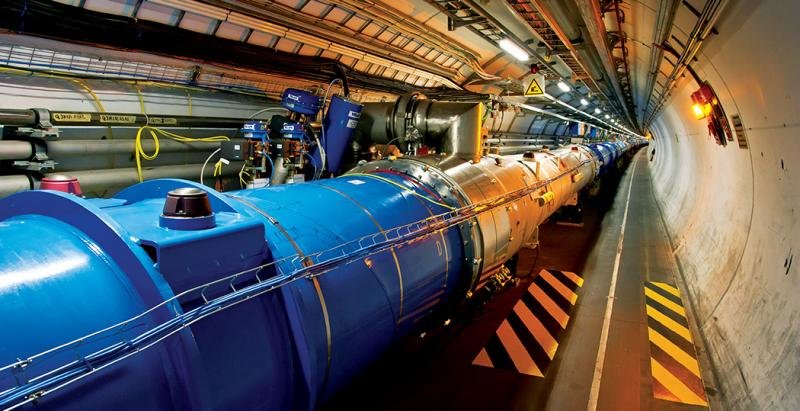
This makes symmetric light ion collisions ideal for investigating the final-state collective response in small collision systems." The team analyzed these collisions with the CMS detector at the CERN Large Hadron Collider, with 5.36 TeV per nucleon pair.
Summary by Nerd News Network. Read the full article at Phys.org via the links above and below.