
NASA 'troubleshooting' transporter for space station's robotic arm [Updated]
Recently, the astronauts on board the International Space Station performed a routine “walk-off” maneuver with the large, 58-foot-long robotic arm attached to the orbiting laboratory.
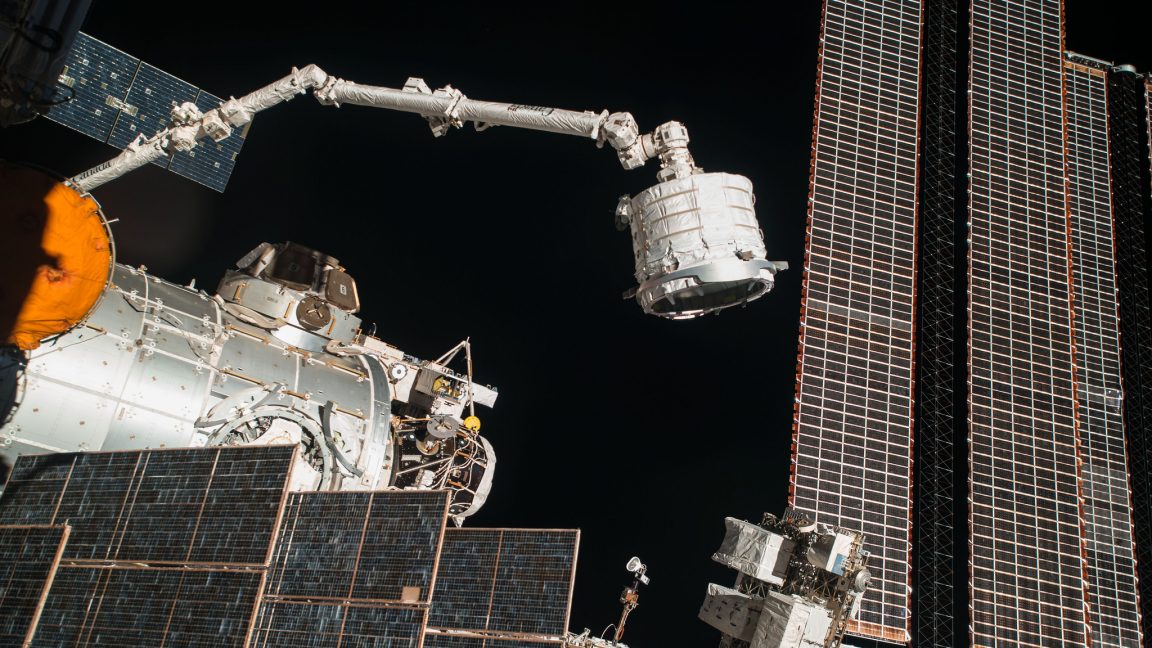
Recently, the astronauts on board the International Space Station performed a routine “walk-off” maneuver with the large, 58-foot-long robotic arm attached to the orbiting laboratory.
The short version
- However, after this particular walk-off maneuver, the robotic arm, along with the mobile transporter that guides it along the main truss of the space station, engineers noted some issues with operations.
- Designed and developed by the Canadian space corporation MDA, the Canadarm2 launched to the International Space Station in April 2001 on Space Shuttle Endeavour , and it has since served as a critical component of the orbiting laboratory.
- Its nominal design lifetime was 15 years, so it has been operating for more than a decade beyond this point.
What happened
The arm has a mass of nearly two metric tons and can handle payloads of up to 116 tons. For much of its lifetime, the arm was essential in getting supplies to the International Space Station.
Why it matters
The first version of SpaceX’s cargo vehicle, as well as Northrop’s Cygnus and Japan’s HTV-X transfer vehicles, was designed to be grabbed by the arm when it got close to the station and then be moved into a berth at the facility.
Summary by Nerd News Network. Read the full article at Ars Technica via the links above and below.