
Scientists may have finally proved that “empty” space isn’t really empty
A magnetar’s colossal magnetic field may have revealed a quantum effect predicted by Werner Heisenberg nearly 90 years ago, in which seemingly empty space alters the behavior of light.
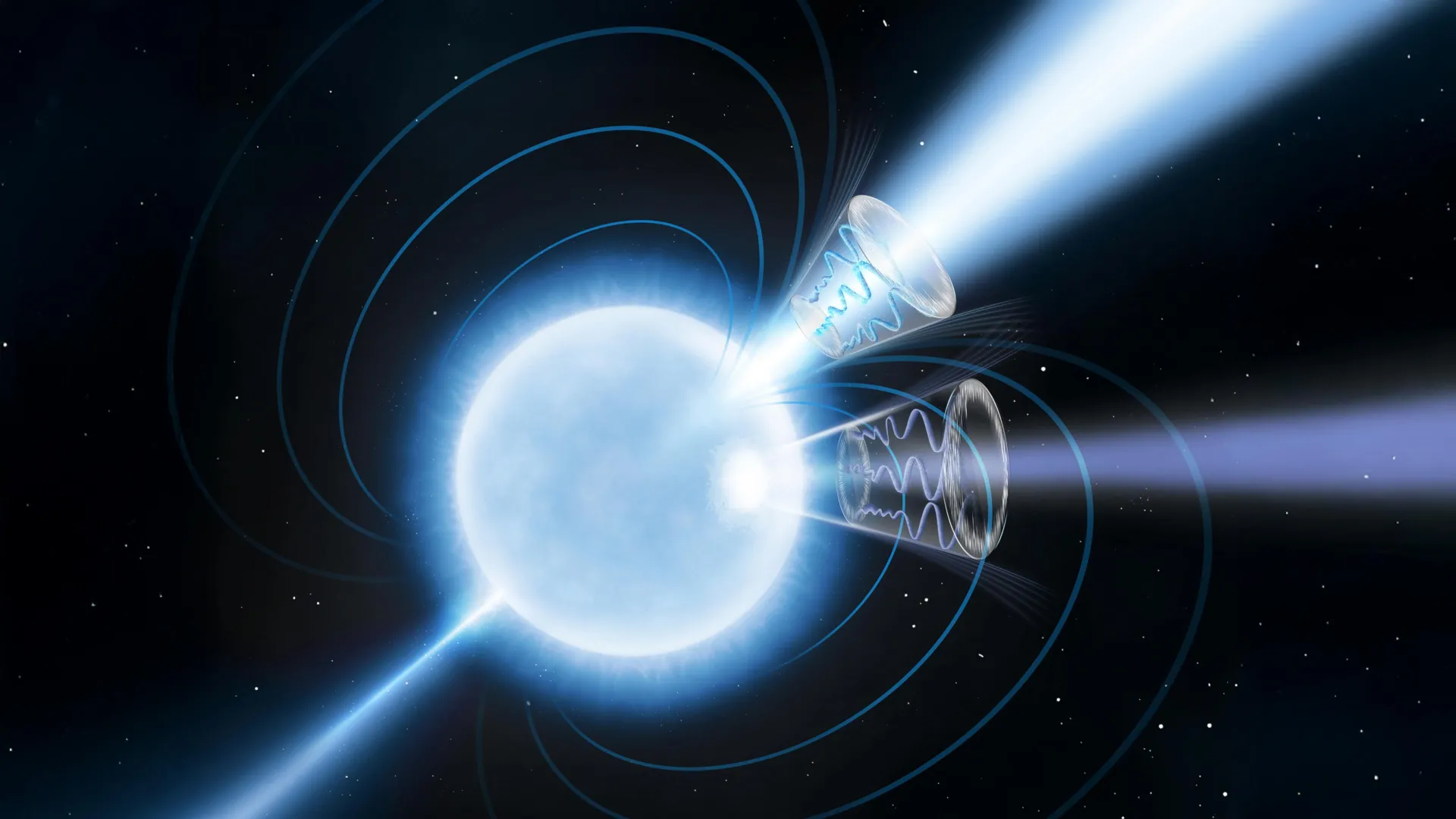
A magnetar’s colossal magnetic field may have revealed a quantum effect predicted by Werner Heisenberg nearly 90 years ago, in which seemingly empty space alters the behavior of light.
The short version
- If confirmed, the discovery could offer the first direct evidence of vacuum birefringence and open a new window into the strange physics of the quantum vacuum.
- Astronomers may have found some of the strongest evidence yet for one of quantum mechanics' strangest predictions: even apparently empty space can influence the way light travels.
- Known as 'vacuum birefringence', the phenomenon was predicted nearly 90 years ago by Werner Heisenberg, one of the pioneers of quantum mechanics.
What happened
His work suggested that a perfect vacuum is not truly empty. Instead, it should contain 'virtual particles' that briefly appear and disappear.
Why it matters
Marcus Lower from Swinburne University of Technology, investigated this long-standing quantum mystery by studying a magnetar, a rare type of neutron star that possesses the strongest magnetic fields known in the universe.
Summary by Nerd News Network. Read the full article at ScienceDaily — Top Science via the links above and below.