
Seven perfect shuffles randomize a deck of cards, but how many sloppy ones?
A new proof extends the famous seven-shuffle result to messier riffle shuffles that do not require magician-level precision.
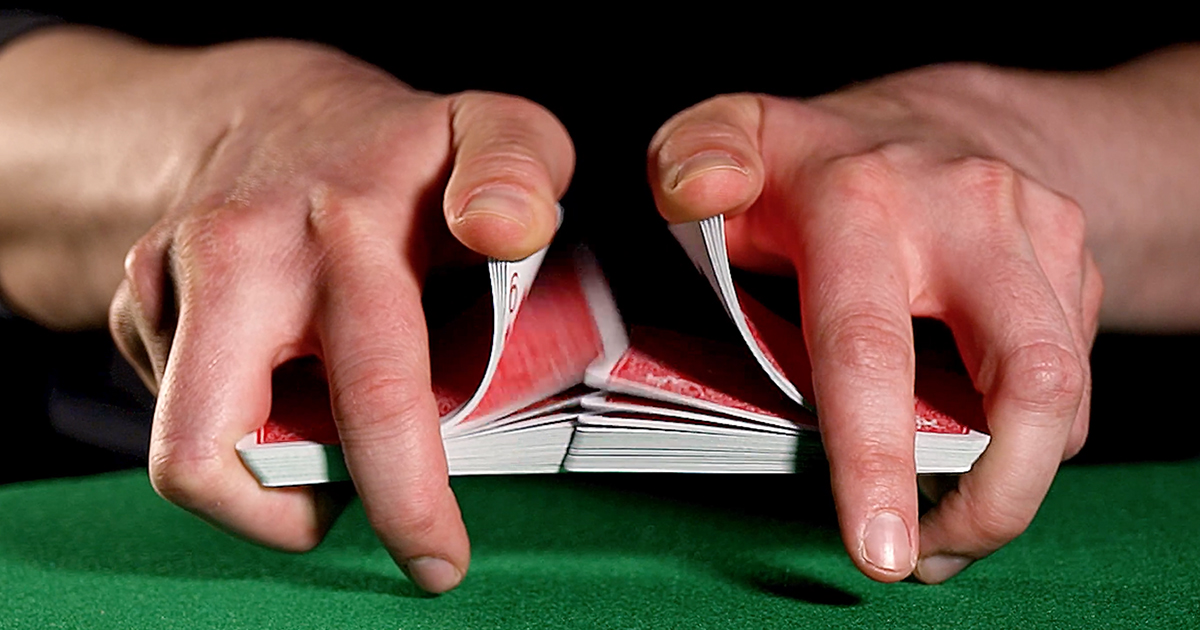
Quanta Magazine covered a new mathematical result about riffle shuffling, the familiar motion of splitting a deck and interleaving the two piles. The classic theorem says seven ideal riffle shuffles are enough to randomize a deck, but real shuffling is rarely ideal.
The short version
- Dave Bayer and Persi Diaconis proved in 1992 that seven precise riffle shuffles create a sharply mixed deck.
- That proof depends on neat assumptions about how the deck is cut and interleaved.
- Mark Sellke, Jialu Shi and Jiamin Wang have now extended the cutoff phenomenon to less exact shuffles.
- The result matters beyond cards because similar sudden transitions appear in other probabilistic systems.
What happened
The older theorem became famous because it showed order disappearing abruptly. Before the seventh ideal riffle shuffle, a deck still retains visible structure; after that point, it looks close to random in a mathematically precise sense.
Quanta reports that the new work relaxes the magician-like constraints. By proving that sloppy riffle shuffles can also show a cutoff, the researchers moved the theory closer to what ordinary humans actually do with cards.
Why it matters
Card shuffling is a friendly doorway into probability, mixing times and dynamical systems. Better theorems about imperfect shuffles help mathematicians understand how randomness emerges when a process is noisy rather than perfectly controlled.
Summary by Nerd News Network. Read the full original at Quanta Magazine via the source link.