
What did the Liberty Bell sound like? Science is on the case.
Researchers hunted for clues in modal analysis of 20th-century replica bell at Penn State Behrend.
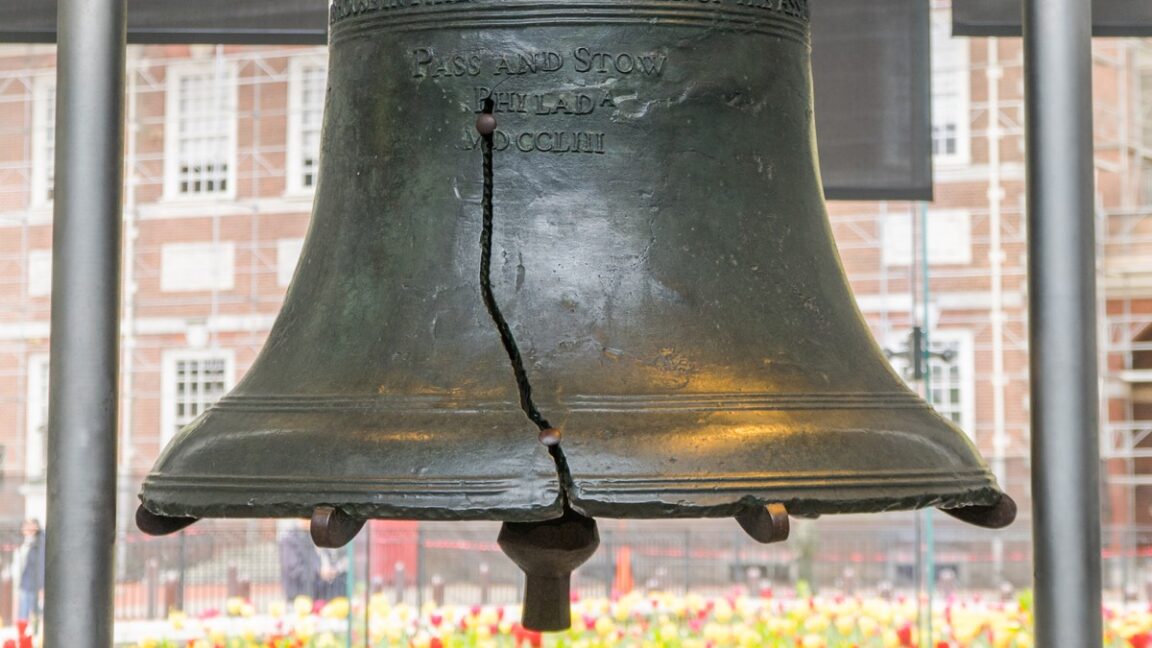
Researchers hunted for clues in modal analysis of 20th-century replica bell at Penn State Behrend.
The short version
- This wasn’t the first time the bell had cracked; the rim cracked shortly after it arrived in Philadelphia in 1752, the first time the clapper struck while testing the sound.
- It was recast by two local foundry workers, John Pass and John Stow, not once but twice, because the first recast produced a sound that one bystander likened to coal scuttles banging together.
- The second recast’s sound was deemed acceptable, and the bell was typically used to summon the Assembly, among other purposes, until it fell into disuse after the American Revolutionary War.
What happened
As for why the bell was so prone to cracking, a 1975 study of the bell’s chemical composition revealed that the metals used formed “an extremely brittle alloy” that also made it easier for souvenir collectors to chip off pieces from the rim. We do know something about the general acoustics of bells, dating back at least to a seminal 1987 paper by Thomas D.
Why it matters
Rossing and Robert Perrin exploring the forms and vibrational modes of church bells, carillon bells, and handbells.
Summary by Nerd News Network. Read the full article at Ars Technica via the links above and below.